Bring Life to Your Living Space
Bring Life to Your Living Space

There’s a specific kind of visual dissatisfaction that comes from walking into a living room and feeling like something isn’t right even when you can’t immediately name the problem. More often than not, the culprit is the wall and space behind the sofa. It’s one of the most overlooked zones in any home, and it has an outsized effect on whether a room reads as thoughtfully designed or merely furnished.
The issue isn’t usually the couch itself. It’s what happens or doesn’t happen in that three-foot stretch between the back of the sofa and the wall, or on the wall above it. Homeowners tend to fall into one of three traps: they push the sofa flush against the wall (which can make a room feel like a waiting room), they pull the sofa forward and leave the gap completely empty, or they style the space so aggressively that it becomes visual noise. The good news is that this zone is actually one of the most flexible and rewarding areas to style once you understand the basic principles.
This guide isn’t about decorating trends. It’s about solving real layout problems with practical, proportional thinking whether you’re working with a narrow townhouse living room, an open-plan apartment, or a sprawling family room anchored by an L-shaped sectional.
The decision to pull a sofa away from the wall what designers call a “floating” furniture layout is one of the most impactful spatial moves you can make. It immediately makes a room feel more intentional, more like a designed space than a showroom floor.
Floating furniture logic is simple: when a sofa is anchored to the center of the room (typically defined by a rug underneath it), it creates a defined conversation zone rather than a room where everything clings to the perimeter. This works especially well in rooms that are wider than they are long, or in any space where you want to create a clear pathway around or behind the seating area.
A good rule of thumb is to leave at least 18 inches ideally 24 to 36 inches between the back of the sofa and the wall. This gap is enough to walk through comfortably and, more importantly, gives you room to introduce a console table behind the sofa without the whole arrangement feeling cramped.
Traffic flow matters here. If pulling the sofa forward creates a narrow pinch point say, less than 30 inches between the couch and another piece of furniture or the room’s entry path, then floating may not be the right call for that particular layout.
Not every room benefits from a floating layout. In very small living rooms, narrow apartments, or spaces where a sofa occupies an entire wall, pushing the sofa back is often the more practical (and visually cleaner) choice. The same applies to rooms with slanted wall decor ideas challenges, like attic conversions or spaces with architectural irregularities where pulling furniture away from the wall creates awkward angles.
When the sofa is against the wall, the decorating challenge shifts entirely to the wall above which is a different but equally manageable problem, addressed later in this guide.
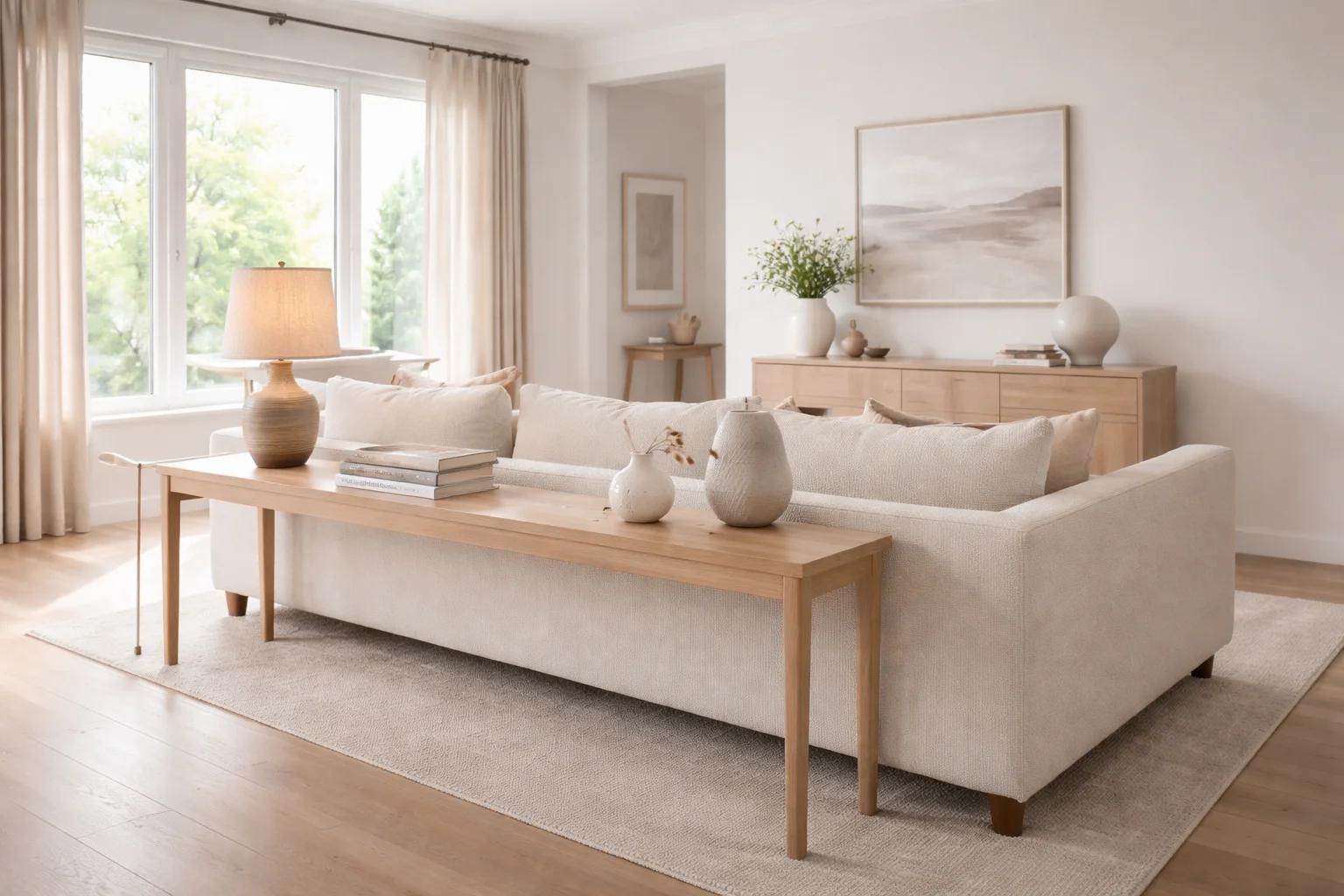
If you’ve pulled your sofa into a floating position and need to define that space, a console table is almost always the right answer. It grounds the back of the sofa visually, adds functional surface area, and gives you a platform for layered styling without cluttering the sofa itself.
The most common mistake with a console table behind a couch is choosing one that’s too deep. Anything over 14 inches in depth starts to eat into walkable floor space and makes the area feel tight. Look for tables in the 10-to-14-inch range these are sometimes labeled as “sofa tables” or “narrow console tables” and they sit comfortably in that gap without dominating it.
Height is equally important. The console table should sit at or slightly below the height of the sofa’s back typically somewhere between 28 and 32 inches. A table that towers above the sofa back looks awkward and disjointed. One that sits too low disappears visually.
As for width, the console table should be roughly two-thirds to the full width of the sofa behind it. A 90-inch sofa paired with a 48-inch console looks unbalanced. A table that spans 70 to 80 inches creates a much more cohesive relationship.
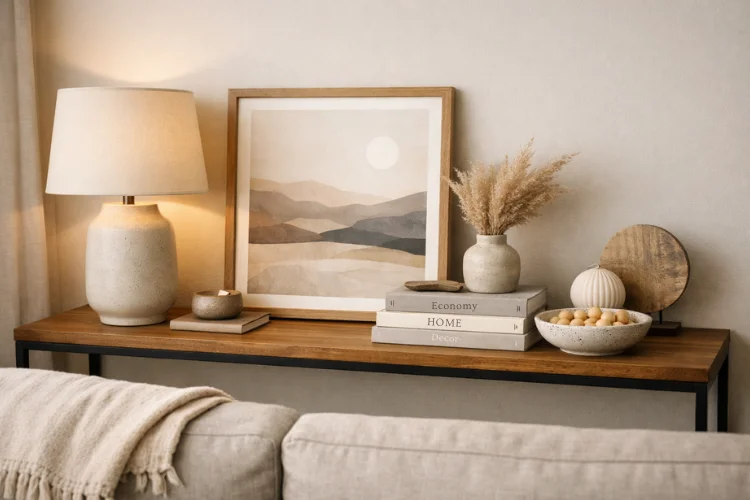
There’s a reliable formula for sofa table styling ideas that works across a wide range of aesthetics. The key is vertical contrast combined with low-lying anchoring elements.
Start with a lamp at one end of the table. A table lamp does two things simultaneously: it adds height variation and it introduces warm, layered light into the room, which makes the space feel far more livable than overhead lighting alone. Choose a lamp whose shade sits at roughly eye level when seated on the sofa around 52 to 58 inches from the floor.
Next, introduce a vertical element behind or adjacent to the lamp. This might be a tall piece of leaning art, a narrow mirror, a cluster of stems in a tall vase, or a sculptural object. This vertical layer prevents the table from reading as flat and one-dimensional.
Finally, anchor the lower portion of the table with something low and grounding a stack of books, a shallow tray with a candle and small objects, a low ceramic bowl, or a small plant. This low element brings the eye back down and creates a sense of deliberate layering.
Not every console table needs to be a purely decorative moment. Tables with a lower shelf are particularly useful behind a sofa because they offer a discreet place to tuck baskets. Woven baskets underneath a console table can hold throws, remotes, board games, or anything else that tends to accumulate in a living room. This is especially worth considering in family rooms, where function often has to keep pace with style.
The space behind the couch in a small living room requires a more edited approach. The goal isn’t to replicate a full styling vignette it’s to add just enough visual definition to make the layout feel intentional without compressing the space further.
In a narrow living room layout where even a standard 12-inch console feels intrusive, consider a table in the 8-to-10-inch depth range. These ultra-slim consoles are available from a number of furniture retailers and are specifically designed for tight spaces. They provide the visual anchor of a console table without encroaching on walkability.
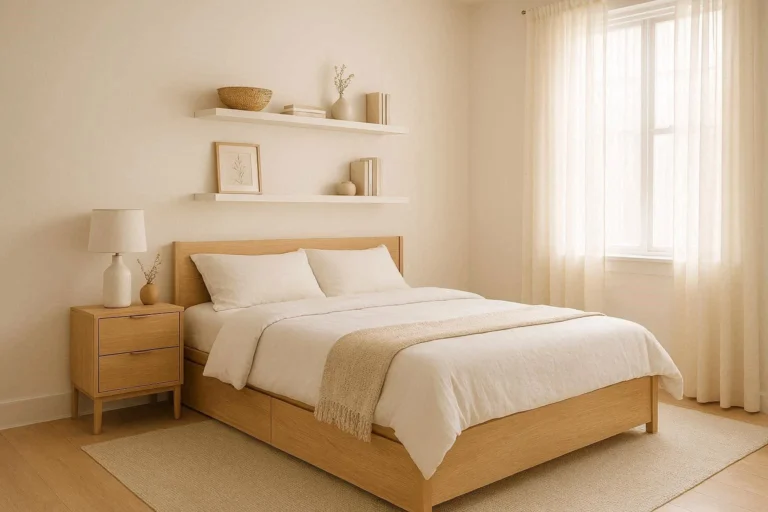
Alternatively, small living room decorating ideas often make excellent use of wall-mounted shelves instead of freestanding furniture. A pair of floating shelves at varying heights behind the sofa gives you the same layering effect as a console table while keeping the floor completely clear. This is particularly effective in apartments and studios where every square foot counts.
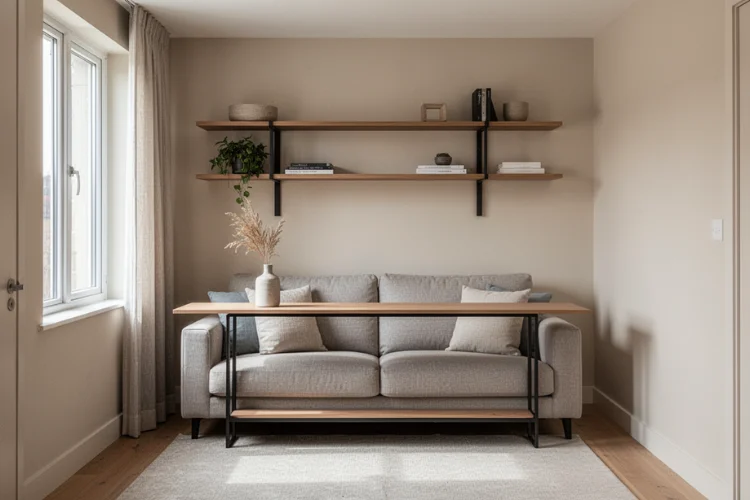
A low upholstered bench placed behind a sofa in a floating layout serves double duty it creates a visual boundary between the sofa grouping and the rest of the room, and it functions as extra seating when needed. Choose a bench that sits about 2 to 4 inches lower than the sofa back so it reads as a deliberate accompaniment rather than a competing piece. Style it with a folded throw and a single tray to keep it from feeling like an afterthought.
In open-plan layouts where the living room flows into a kitchen, dining area, or home office the space behind the couch becomes one of the best tools for visual separation without physical walls.
A console table behind a floating sofa essentially acts as the back wall of the seating zone. It signals where the living area ends and another space begins. This is one of the most elegant solutions to the open-plan layout challenge: instead of relying on rugs alone to define zones, you use furniture height and placement to create implied partitions.
For stronger separation, consider a sofa table with a backing panel, or place a narrow bookshelf behind the sofa with its open side facing the adjacent zone. The shelving serves as both a room divider and a display surface.
One of the more practical space-behind-couch ideas that’s become increasingly popular is placing a small desk directly behind the sofa. This works especially well in studio apartments or one-bedroom homes where a dedicated home office isn’t possible.
The setup works when the console is at desk height typically 28 to 30 inches and the chair or stool is positioned so that the sofa back acts as a visual barrier between “work” and “rest.” Keep the desk surface relatively edited to prevent the seating area from feeling visually chaotic.
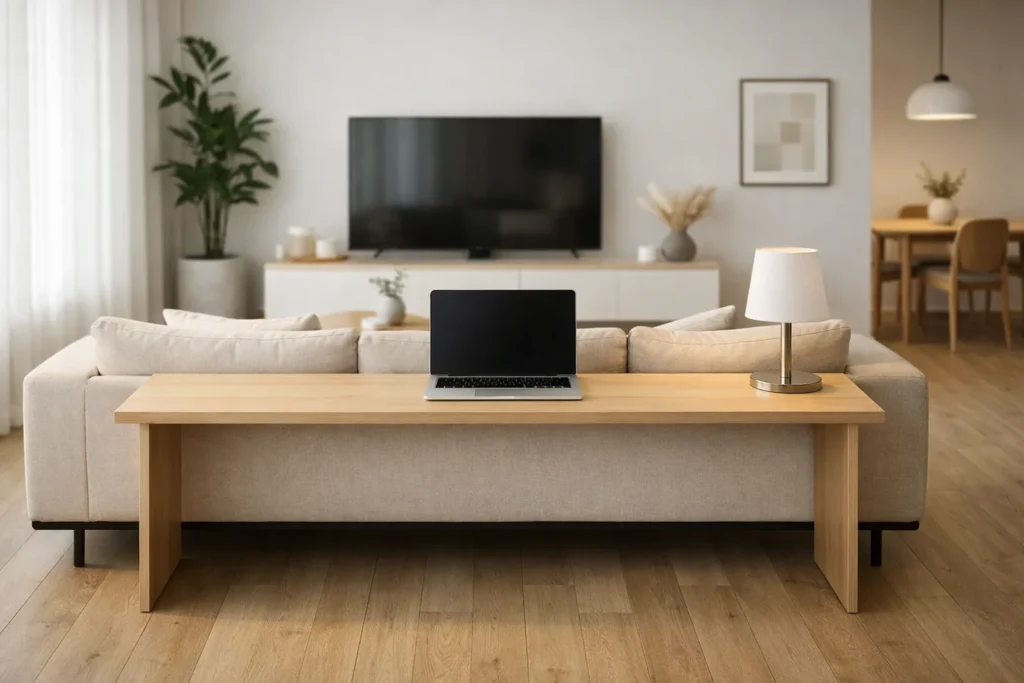
In larger rooms, the space behind a floating sofa can become the back wall of a small reading nook a chair, a floor lamp, and a side table tucked into the corner created by the sofa’s position in the room. This arrangement makes the room feel richer and more layered, as if it contains multiple worlds rather than just one seating configuration.
When the sofa is positioned against the wall either by necessity or choice the decorating work moves entirely to the wall above it. This is where most homeowners either play it too safe (nothing on the wall at all) or overreach (a gallery wall that’s too small or too chaotic).
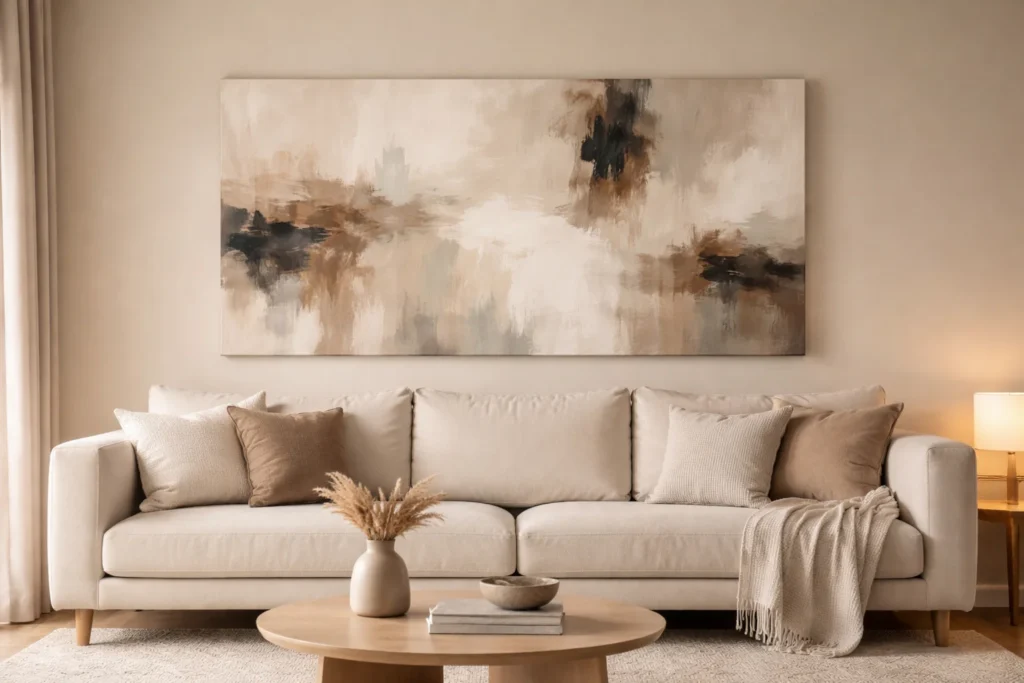
If you’re choosing a single piece of artwork to hang above a sofa, bigger is almost always better. The art should span at least two-thirds the length of the sofa for a 90-inch sofa, that means looking for pieces at least 60 inches wide. Hanging art that’s too small above a large sofa creates the visual equivalent of wearing a tie that’s too short: it just looks off.
The bottom of the art frame should hang 6 to 8 inches above the top of the sofa back. Lower than 6 inches and it feels like the art and the furniture are crowding each other. Higher than 10 to 12 inches and the art floats untethered from the sofa below it.
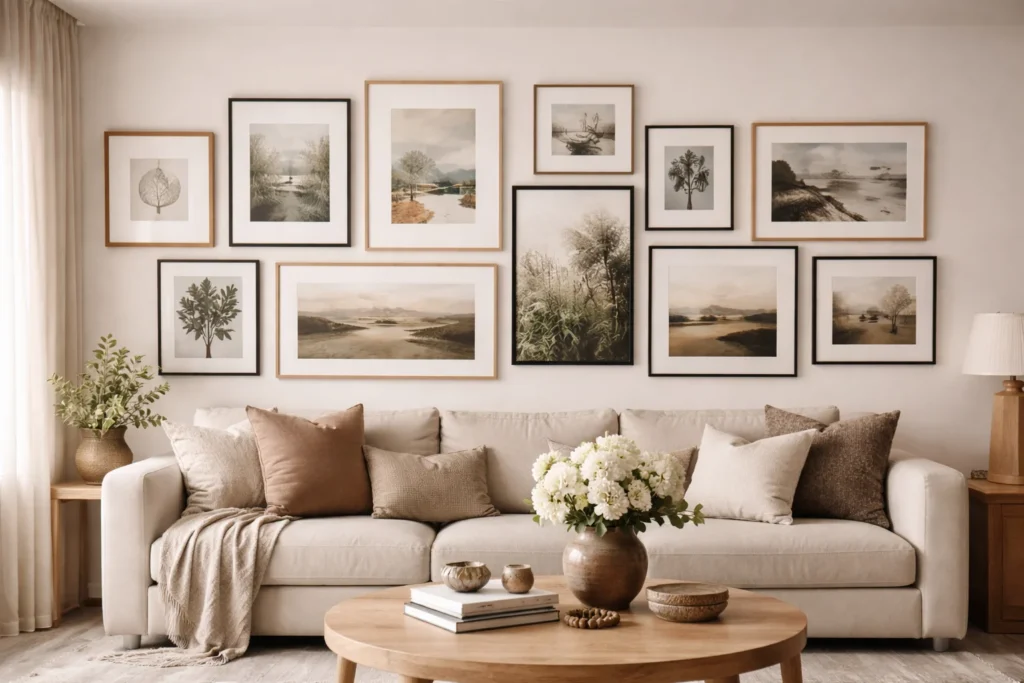
A gallery wall is a strong choice for decor behind a sofa when you want warmth and texture over minimalism. The most common mistake here is making the gallery too small a cluster of frames covering only the central third of the wall above a long sofa reads as timid. The arrangement should span close to the full width of the sofa, or at minimum, its visual center.
For a cohesive result without rigidity, stick to frames in two or three finishes (for example, black, brass, and natural wood) and vary the sizes of the pieces within the arrangement. Start by laying the arrangement out on the floor, photograph it from above, and use that as your hanging guide. For broader layout strategies and affordable styling concepts across different rooms, explore our curated decorating resources.
A symmetrical arrangement one large piece flanked by two matching sconces or identical smaller pieces works well in traditional, transitional, and formal living rooms. It reads as composed and settled.
Asymmetry is better suited to eclectic, contemporary, or bohemian interiors where a bit of deliberate imbalance feels more alive. The key to making asymmetry work is having one dominant anchor piece (the largest or most visually weighted item) and arranging everything else in relationship to it.
A large mirror above a sofa is one of the most effective tools in a small or dark living room. It reflects light, adds the illusion of depth, and introduces an element of elegance without the commitment of a fixed art choice. On floors with dark hardwood floors decorating ideas, a well-placed mirror can dramatically brighten a space by bouncing both natural and artificial light around the room.
Scale matters: choose a mirror that spans at least 24 to 36 inches in width for a standard sofa, or larger for sectionals and long sofas. Leaning a large mirror on the floor behind a console table is another option that brings in a more casual, contemporary feel.
Sectional sofas present a unique challenge because their L-shaped footprint means there isn’t always a clean, uninterrupted wall running behind them. The longer side of the sectional typically backs up against one wall, while the chaise or shorter return juts out into the room.
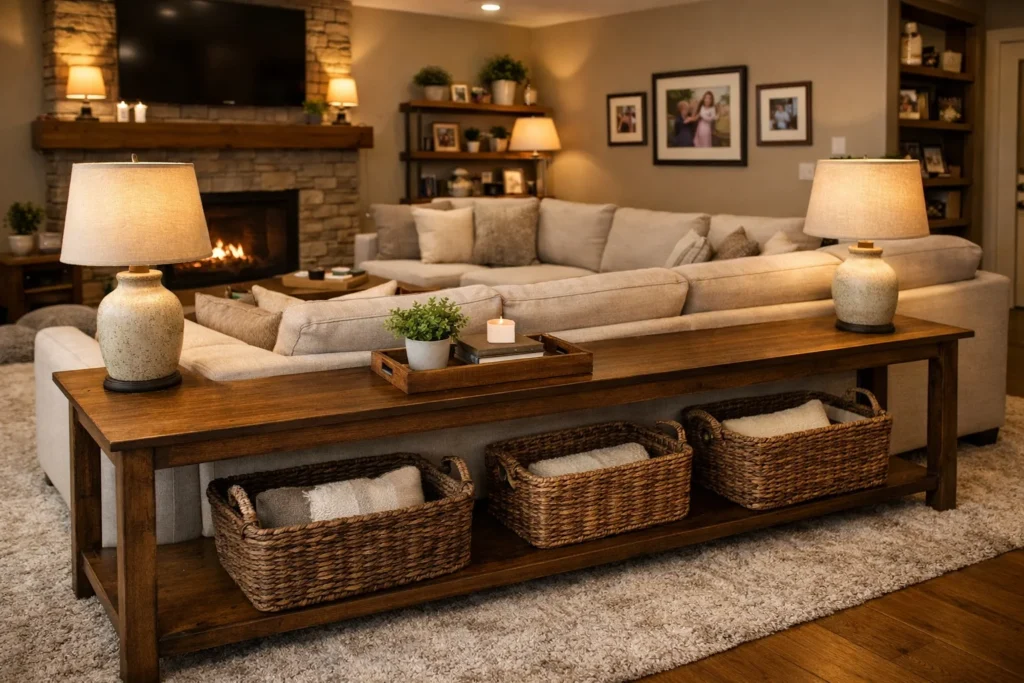
For the back of the long side of the sectional, all the same console table and wall decor rules apply. The visual weight of a sectional, however, demands more both in terms of furniture scale and wall art size. A 60-inch console behind a 110-inch sectional looks undersized. Aim for a table that spans at least 70 percent of the sofa’s length.
The corner where the L turns is often where the layout becomes tricky. A round accent table or a corner-specific console the kind with a 90-degree back edge designed to fit a corner can address this beautifully, adding presence and function to what would otherwise be a dead zone.
Because sectionals dominate a room, decor behind them needs to be confident. Oversized art, tall floor lamps, and substantial console tables are all appropriate. Fussy, small-scale decor tends to disappear against the visual mass of a large sectional and makes the arrangement feel unresolved.
Lighting in the zone behind the sofa is often the element that elevates a room from “nicely styled” to “genuinely inviting.” The living room relies too heavily on overhead lighting in most homes which flattens the space and drains warmth. The space behind the sofa is prime territory for building out a layered lighting strategy.
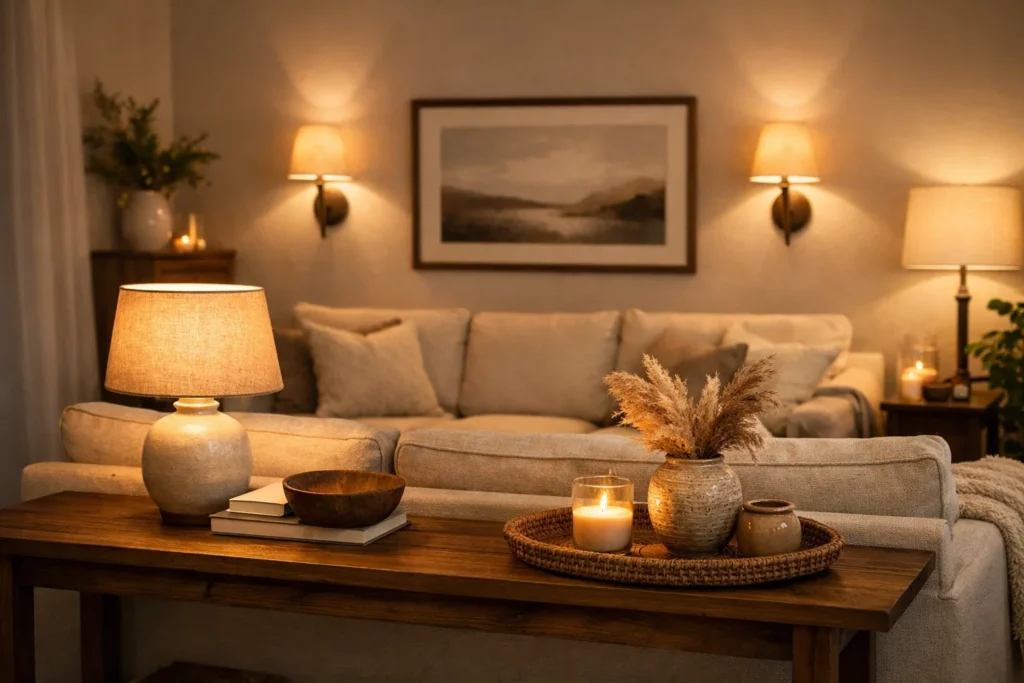
As mentioned in the console table styling section, a table lamp on the console behind the sofa is one of the most practical lighting additions you can make. It creates a warm pool of light that reads as atmospheric in the evening and functional when the room is in use. Use lamps with opaque or semi-translucent shades to direct light downward rather than outward this creates coziness rather than glare.
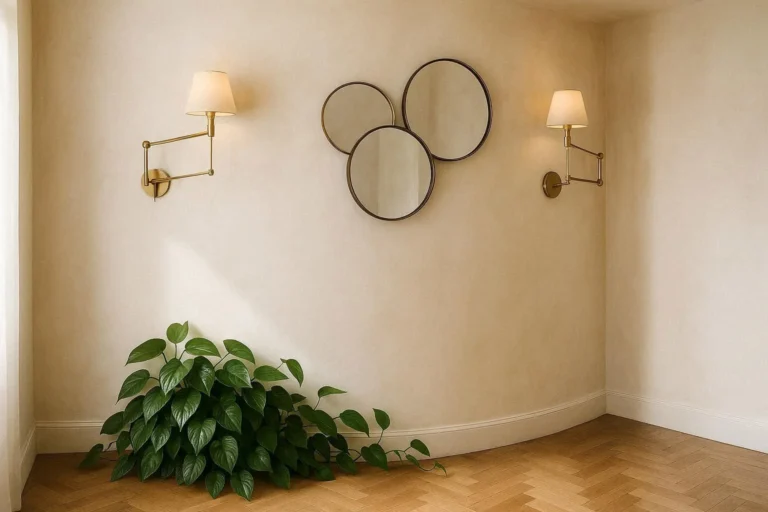
Wall sconces flanking art or a mirror above a sofa provide beautiful symmetry and eliminate the need for table space. They’re particularly useful when the sofa is against the wall and there’s no console table to hold lamps. Choose sconces with an adjustable arm if possible this gives you flexibility in directing light where it’s needed.
In a floating sofa layout, a floor lamp positioned at one end of the console table or even just behind and beside the sofa adds height variation and fills an area that can otherwise feel spatially thin. Arc floor lamps are especially useful here because their sweeping arm can direct light over the sofa for reading without the lamp itself occupying prime floor space.
Even with the right intentions, the space behind a sofa can go wrong quickly. These are the most common errors worth watching for.
Decor that’s too tall. The space behind a floating sofa should feel like a secondary layer, not a competing focal point. Anything that rises dramatically above the sofa back an oversized floor lamp at the wrong scale, a towering vase, shelving that looms can make the seating area feel overshadowed.
Blocking traffic. Before committing to any furniture or styling in this zone, walk the path. If placing a console table means someone has to turn sideways to move through the space, the table is too deep or the sofa is too far from the wall.
Overcrowding the surface. A console table behind the sofa isn’t a shelf it’s not meant to hold everything that doesn’t have another home. Three to five objects arranged with breathing room will always read better than a densely populated surface.
Wrong-scale furniture. A delicate, spindly console behind a substantial, deep-seated sofa looks mismatched. The visual weight of the console should complement the visual weight of the sofa. A robust, thick-legged sofa needs a more substantial table; a slim, modern sofa can carry a more delicate console.
In a townhouse decorating ideas scenario typically a long, narrow room with limited wall space a slim 10-inch console in a dark finish runs behind the sofa. A single table lamp at one end, a small framed print leaning against the wall, and a low woven tray provide just enough layering. Wall sconces flank a horizontal mirror above, adding light and the illusion of width.
A mid-century modern sofa pulled 24 inches from the wall has a walnut console table behind it, 72 inches wide and 12 inches deep. A tall textured vase on one side, a stack of art books, and a brass lamp on the other end create a composed but casual arrangement. The wall behind is deliberately left empty, letting the console and lamp carry the visual work.
A large sectional in a family room has a 78-inch console behind the long side, styled with two matching lamps (one on each end), a gallery of framed photos across the wall above, and three baskets on the lower shelf for throw storage. The look is warm, highly functional, and scaled to the room.
A cream linen sofa in a pale room floats away from the wall, backed by a thin white console. A single oversized plaster-finish ceramic vessel is the only object on the surface. The wall above holds one large-scale abstract print in pale tones. Nothing competes; everything breathes.
A deep velvet sofa in forest green is backed by a natural wood console layered with a mix of objects: a rattan lamp, a stack of books with a small trailing plant on top, a collection of small sculptures, and a low brass tray. Above, a large woven textile hangs from a wooden dowel. The layering is intentional and dense, but each element has been chosen for texture and scale rather than default.
The most common and effective solution is a console table, also called a sofa table, positioned 4 to 12 inches behind the sofa back. Styled with a lamp, a vertical element, and low decorative objects, it defines the seating zone and adds warmth. Alternatives include a narrow bench, wall-mounted shelves, or a low bookshelf used as a room divider in open-plan spaces.
Not necessarily. Floating a sofa away from the wall with 18 to 36 inches of clearance behind it creates a more intentional, designer-feeling layout and allows you to use the space behind the sofa actively. That said, in small rooms or narrow layouts where traffic flow would be compromised, keeping the sofa against the wall is the better practical choice.
A console table behind a couch should sit at approximately the same height as the sofa back or just slightly below it typically between 28 and 32 inches. A table significantly taller than the sofa back creates visual disconnection; one that’s too low disappears behind the cushions.
Yes, and it’s one of the more creative and functional space-behind-couch ideas for apartments or small homes. The desk should be at standard desk height (28 to 30 inches) and positioned so the sofa back acts as a visual and psychological divider between work and rest zones. Keep the desk surface minimally styled to prevent it from visually intruding on the living area.
Art hung above a sofa should span at least two-thirds the length of the sofa for a standard 84-inch sofa, that means a piece at least 56 inches wide. The bottom of the frame should hang 6 to 8 inches above the sofa back. Going larger than this formula is generally fine; going significantly smaller typically looks sparse and unintentional.
The space behind a couch rewards patience and proportion more than it rewards impulse. The most polished-looking living rooms aren’t filled with more they’re filled with the right things, in the right relationship to each other and to the room. Whether you’re working with 10 inches or 3 feet behind your sofa, the principles remain the same: anchor the space with something intentional, build up in layers rather than all at once, and let the scale of what you add speak to the scale of the sofa it accompanies.
A well-considered space behind the sofa doesn’t announce itself. It simply makes the whole room feel like it was meant to look exactly this way.