Bring Life to Your Living Space
Bring Life to Your Living Space

There’s a particular frustration that comes with decorating a small living room. You browse design accounts, fall in love with an arrangement, order the sofa and then stand in your 180-square-foot apartment wondering why nothing looks the way it did in the photograph. Small spaces are unforgiving in ways larger rooms are not. Scale errors are immediately obvious. Clutter has nowhere to hide. And the wrong layout choice can make even a well-furnished room feel like a waiting area.
Small living room decorating ideas are everywhere, but most of them skip the foundational work: layout, proportion, and the psychological weight of what you choose to put in a room. That’s what this guide focuses on. Before you buy anything, hang anything, or paint anything, there are decisions to make that will determine whether your room feels tight and chaotic or calm and considered.
The single most effective thing you can do in a small living room is understand how people move through the space and arrange furniture around that movement not around aesthetics. Visual appeal follows function in tight spaces, not the other way around.
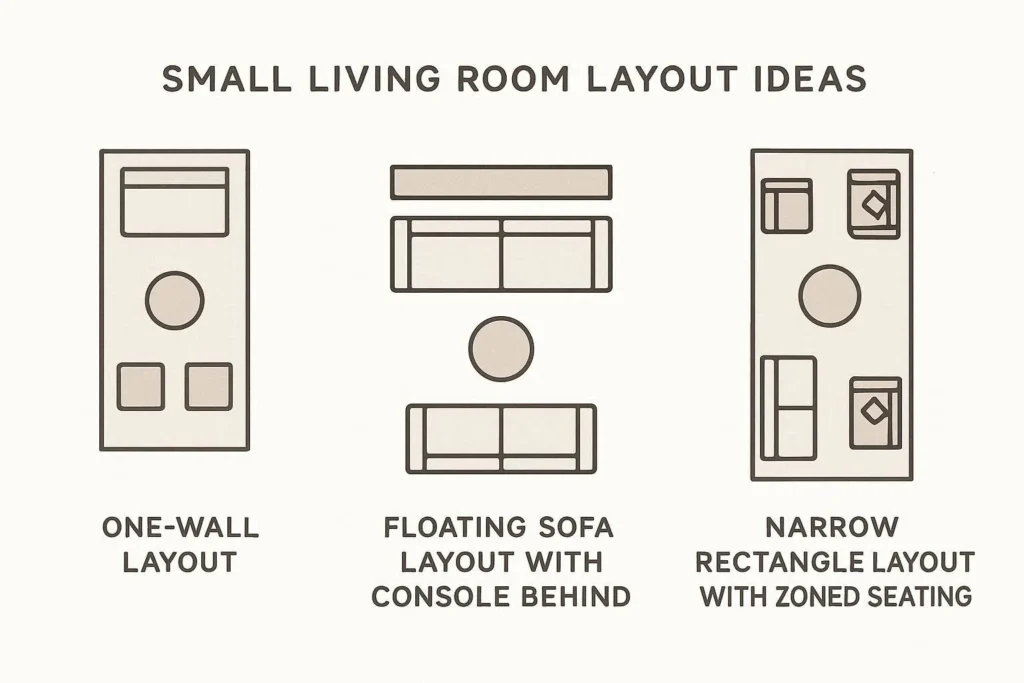
One-Wall Layout Everything lines up against a single wall: sofa, console, possibly a side chair. This works well in rooms under 150 square feet where floor space needs to remain open. The downside is it can feel like furniture is waiting to be used rather than being lived in. Counter this by floating a small rug in front of the sofa and angling a side chair slightly toward it.
Floating Sofa Layout The sofa sits away from the wall, with a console table tucked behind it. This is counterintuitive in tight rooms, but pulling a sofa 12 to 18 inches from the wall creates a sense of depth that makes the room read larger. It also opens up circulation paths along the perimeter. In rooms around 180 to 220 square feet, this is often the best option.
Narrow Rectangle Layout Rooms that are significantly longer than they are wide require a different approach. Furniture placed perpendicular to the long walls creates zones and breaks the tunnel effect. Two chairs facing each other at the far end of the room, or a small bench at the end of the seating area, helps terminate the space visually.
Walkways need to be at least 30 inches wide, and ideally 36 inches, for comfortable movement. If you can’t maintain that clearance around your main seating arrangement, the room feels obstructed before anyone sits down.
Coffee table clearance should be 16 to 18 inches from the front edge of your sofa. This is enough space to reach forward comfortably without the table feeling so far away it’s useless. In a room where every inch counts, resist the impulse to push the coffee table against the sofa to free up floor space it doesn’t actually feel more open that way.
Rug sizing is where most people go wrong. In a 12 x 14 foot room, a 5 x 8 rug will look like a bath mat. You want the front legs of all major seating pieces on the rug, with the rug extending at least 6 inches beyond the outermost furniture leg on each side. An 8 x 10 or even a 9 x 12 rug often works better in a room than you’d expect it anchors the space instead of fragmenting it.
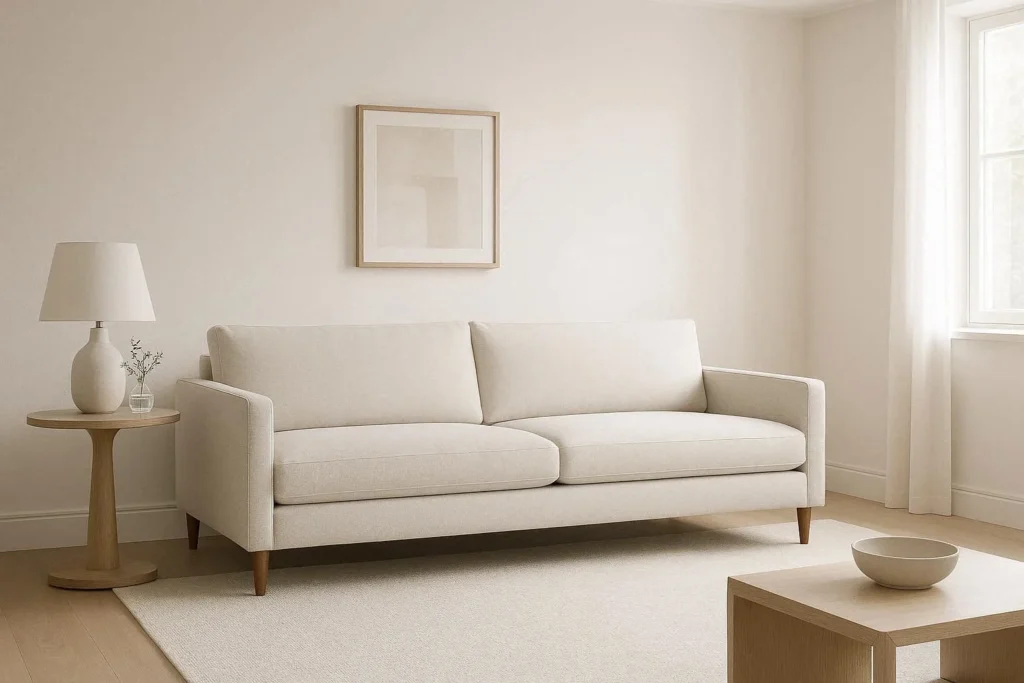
The sofa is the room’s center of gravity. Get this decision wrong and nothing else will compensate for it.
For rooms under 250 square feet, look for apartment-size sofas in the 72 to 84 inch range. These are proportioned for smaller rooms without feeling like scaled-down versions of standard pieces. A standard 96-inch three-seater will dominate most small living rooms, leaving circulation paths that feel pinched.
Avoid sofas with bulky rolled arms. These arms can add 6 to 8 inches per side of visual and physical bulk without adding any seating. Track arms arms that are flush with the seat cushion create a cleaner profile that reads as less massive in tight rooms.
Low-profile sofas (seat height around 16 to 18 inches, back height around 30 to 32 inches) let your eye travel further across the room, which makes the space feel larger. High-back sofas create a visual wall that compartmentalizes the room. High backs can work in open-plan layouts where you want to define the living zone, but in a dedicated small living room they often feel enclosing.
A sectional in a small living room is almost always too much but with conditions. If the room has an awkward corner that wastes space, a small L-shaped sectional (around 95 x 95 inches or smaller) can actually fill that corner efficiently. The problem comes when people buy full-sized sectionals and try to make them fit rooms where they don’t belong. If you’re considering a sectional, measure the room with tape on the floor first and live with those dimensions for a few days.
Sofas and chairs with exposed legs create visual clearance at floor level, making the room feel lighter. A sofa that sits directly on the floor reads as heavier and more space-consuming, even if the actual footprint is identical.
Walls in a small room do significant work. They’re not just backgrounds they’re design surfaces that either create the illusion of space or collapse it. If your living room shares space with other zones like a dining or bedroom area, you may also benefit from reading white wall bedroom decorating ideas to understand how tonal layering creates visual continuity in small homes.
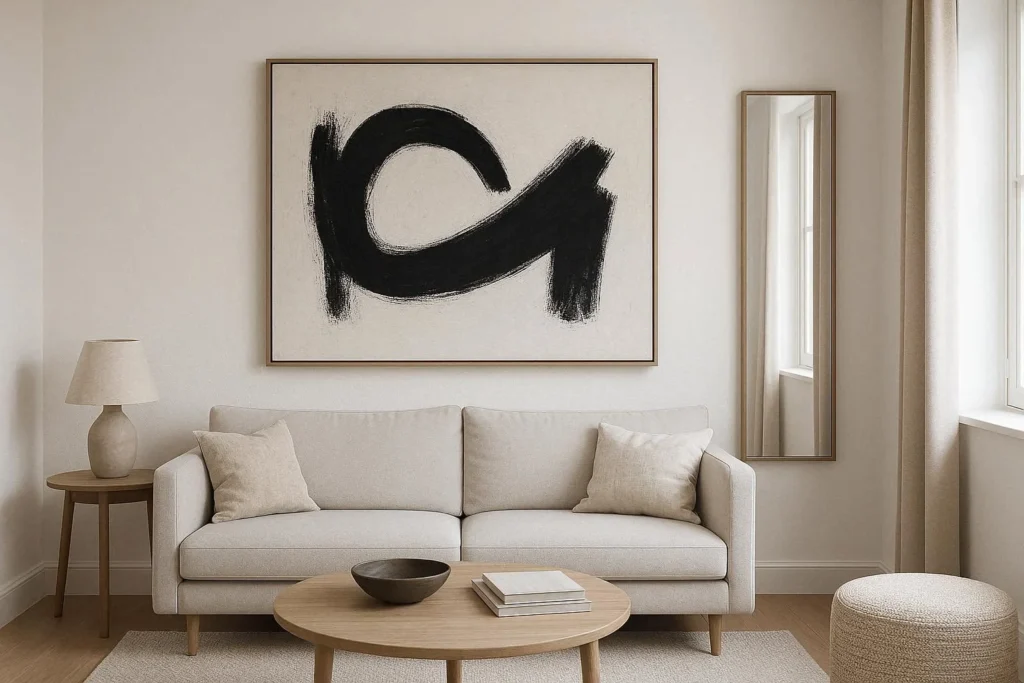
The goal in a small room is to draw the eye upward. This means thinking about wall decor in vertical terms. A tall, narrow mirror placed beside a window adds light and height. A bookshelf that extends to the ceiling (or close to it) commands the eye upward and creates the impression of a taller room without structural changes.
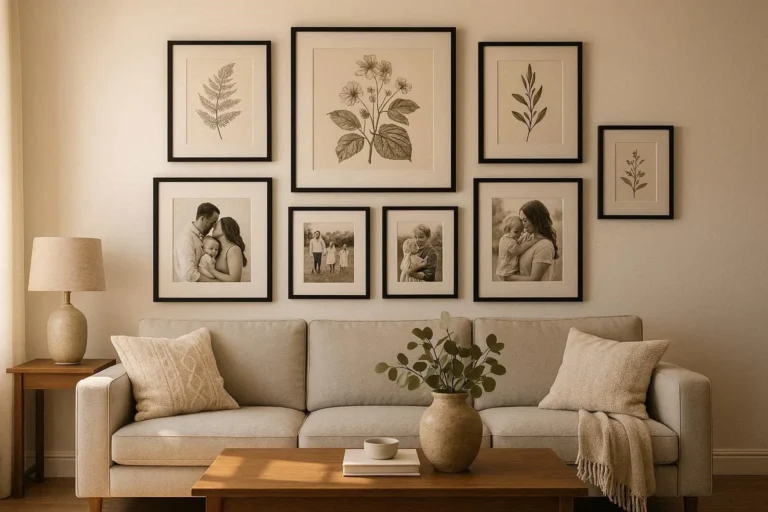
When thinking about what goes behind the sofa, consider one substantial piece of art hung at eye level (center of the image at approximately 57 to 60 inches from the floor) rather than a gallery wall of small frames. Small gallery walls in tight rooms look busy and fragment the wall surface rather than expanding it. For more specific ideas on how to treat the wall directly behind a sofa, see behind couch decorating ideas for a deeper breakdown of what works at different scales.
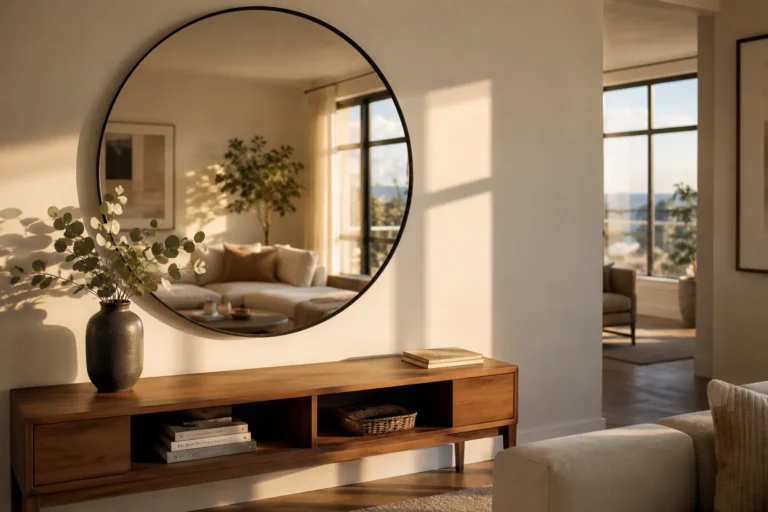
A mirror only functions as a space-expander when it reflects something worth seeing a window, a well-lit corner, a plant. A mirror that faces a blank wall or a crowded shelf reflects more chaos, not more light. Place mirrors perpendicular or at an angle to windows, or on the wall directly opposite a window, to maximize light reflection.
Restraint is a legitimate design choice. A wall that’s left open reads as negative space breathing room that makes the decorated areas feel more intentional. Not every surface needs to be filled. If your room has three windows, a sofa, and bookshelves on one wall, the fourth wall may work best completely bare.
Most people in small spaces never look up, which means the ceiling remains an underused design surface. More importantly, the vertical space between your furniture and ceiling is where scale decisions are either supported or undermined.
Pendant lighting hung from the ceiling draws the eye upward and creates a sense of height that floor lamps or table lamps can’t replicate. In a living room, a pendant (or two) hung over a side table or reading area signals intentionality. The fixture doesn’t need to be large even a simple bare-bulb pendant at 6 to 7 feet from the floor changes how vertical the room feels.
Wall-mounted sconces solve two problems at once: they free up floor and surface space while providing layered light at mid-height. This is particularly useful in rooms where every flat surface is working hard for storage or display.
If you want to explore vertical styling further, these ceiling hanging decor ideas break down what works in compact and low-ceiling rooms.
Tall furniture that stops 8 to 12 inches below the ceiling creates a gap that reads as unfinished. Either take furniture all the way to the ceiling (or very close), or keep it low enough below 48 inches that the upper walls remain open. The awkward middle zone is where visual heaviness accumulates.
Storage in small living rooms has to pull double duty: solve organizational problems without making the room feel smaller or more cluttered.
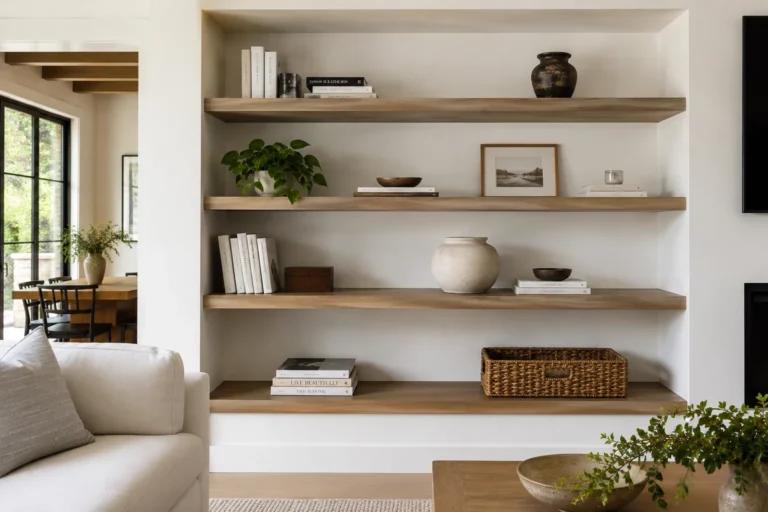
Shelves mounted at 72 inches or above use airspace rather than floor space. This is one of the highest-leverage moves in small space design. Even one long shelf running the length of a short wall, positioned near the ceiling, adds substantial storage while keeping the floor below visually open. Keep what’s displayed on high shelves simple baskets, a few books, a plant to avoid making the room feel cluttered when you look up.
A console table behind a floating sofa, or along a narrow wall, provides surface space and can store items on lower shelves. Look for consoles 10 to 14 inches deep anything deeper starts competing for walkway space.
An ottoman that opens for storage is arguably the most efficient piece of furniture in a small living room. It replaces a coffee table, provides additional seating, and stores blankets, remotes, or other living room items without adding any visual footprint.
Open shelving is useful in small rooms because it prevents the visual mass of large cabinet fronts but only if what’s on the shelves is organized and deliberately arranged. Open shelving that holds random objects looks like clutter. Closed storage (cabinets, drawers, storage ottomans) hides mess but can look bulky. In most small rooms, a mix works best: closed storage below the 36-inch mark, open display above.
Color affects how we perceive spatial volume more than almost any other design decision, and it works through mechanisms that are both optical and psychological.
Light neutrals warm whites, soft greiges, pale sage, ivory reflect light back into the room, which makes walls appear to recede. This creates the perception of distance. That said, all-white rooms in small spaces can feel clinical if there’s no variation in texture or tone. A monochromatic approach using three or four values of the same hue a pale sage on the walls, a deeper sage on an accent pillow, a sage-toned rug creates depth without visual competition.
Yes, and sometimes dramatically well. A dark color on all four walls, ceiling, and trim creates an enveloping effect that makes the room feel like a deliberate destination rather than an unfortunate size. The psychological mechanism is different: instead of the room feeling expanded, it feels cohesive and intentional. This works best when you have good lighting and don’t rely on natural light as your primary source.
Accent walls in small rooms usually work against you. A single darker wall in an otherwise light room draws attention to the room’s dimensions and interrupts the visual continuity that makes a room feel larger. If you want contrast, introduce it through textiles, art, and furniture rather than paint.
Every piece of furniture that contrasts sharply with the wall color adds a visual “object” to the room’s perceived fullness. A charcoal sofa against a white wall reads as very present. The same sofa in a warm oatmeal against a warm white wall reads as quieter. In small rooms, keeping furniture and walls within a closer tonal range makes the room feel less busy.
Narrow rooms those where one dimension is significantly shorter than the other, like a 10 x 18 foot space present a specific challenge. The long axis draws the eye down the tunnel rather than making it feel like a coherent room.
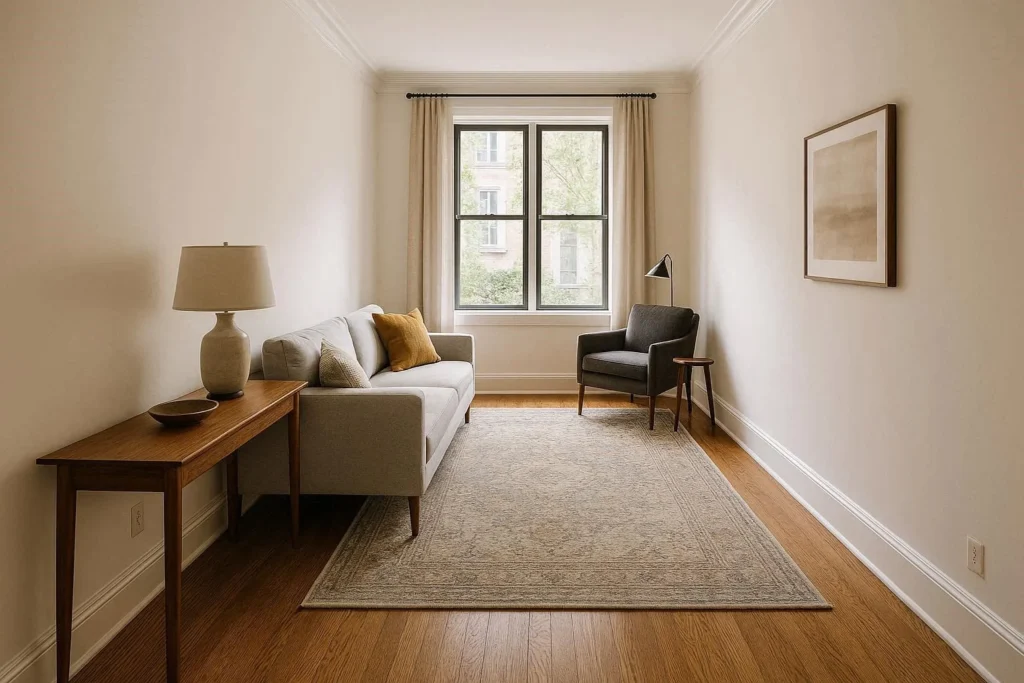
The most effective solution is to create two distinct zones within the narrow rectangle. A seating arrangement at one end, and a separate reading or work area at the other, transforms a corridor into two purposeful spaces. A rug in each zone, even if the rugs are different sizes, signals the division without physical barriers.
In narrow rooms especially, resist the impulse to push all furniture against the walls to preserve walking space down the center. This makes the room feel like a hallway. Instead, pull the sofa forward so there’s a walkway between it and the wall behind it, and use the space behind the sofa for a narrow console. This counterintuitive arrangement makes the room feel wider.
This approach connects to broader townhouse decorating ideas, where long narrow footprints are common across multiple floors and the challenge of managing them is the same throughout.
A long, unbroken wall in a narrow room amplifies the sense of being in a corridor. Break it up with a piece of art that has strong horizontal composition, a low bookshelf, or a pair of sconces at intervals. The eye needs stopping points to register the wall as a surface rather than a passageway.
Most small space design problems can be solved with arrangement and restraint before they require spending. Start there.
Before purchasing anything, take everything out of the room and start fresh. Most people inherit a furniture arrangement and work around it without questioning whether it’s optimal. Moving a sofa from a wall to a floating position, rotating the main seating to face a different direction, or removing one piece of furniture entirely can transform the room at zero cost.
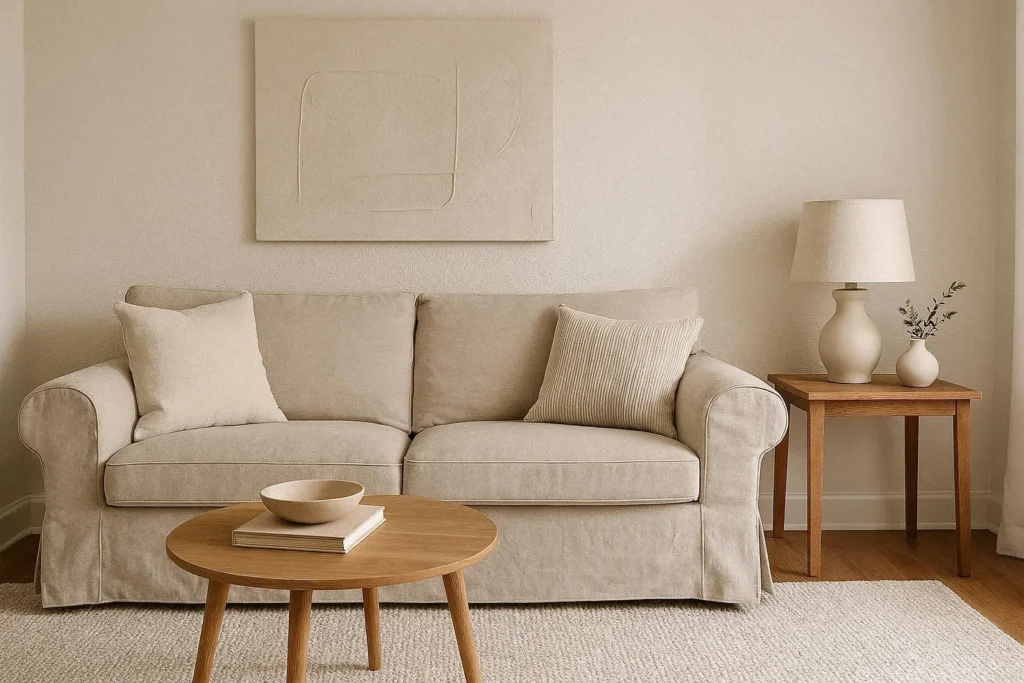
A well-fitted slipcover can update a worn sofa for under $100 and completely change the room’s color story. Linen-blend slipcovers in neutral tones look significantly more expensive than they cost and launder well in small spaces where furniture sees daily use.
At roughly $30 to $60 per gallon, paint is the highest return-on-investment change you can make to a room. A fresh coat in a considered color even the same color the room already is resets the room’s baseline. If you’re renting and can’t paint walls, paint the inside of a bookshelf or a piece of furniture.
Large-scale art changes how a wall functions in a small room, but original art or large prints can be expensive. Canvas stretcher bars from an art supply store and fabric from a fabric store can produce a 24 x 36 inch or larger textile piece for under $40. Simple geometric forms in two or three tones from your existing palette read as intentional and scale-appropriate.
Thrift stores and marketplace apps are most useful when you’re looking for specific things: a lamp of a certain height, a mirror of a certain size, a side table with a particular profile. Shopping thrift stores with open-ended intent leads to accumulation of things that don’t quite work. Go with a list.
A single overhead fixture the default in most apartments creates flat, shadowless light that makes rooms feel smaller. A three-layer lighting approach adds depth and makes the room feel larger at night than it does in daylight.
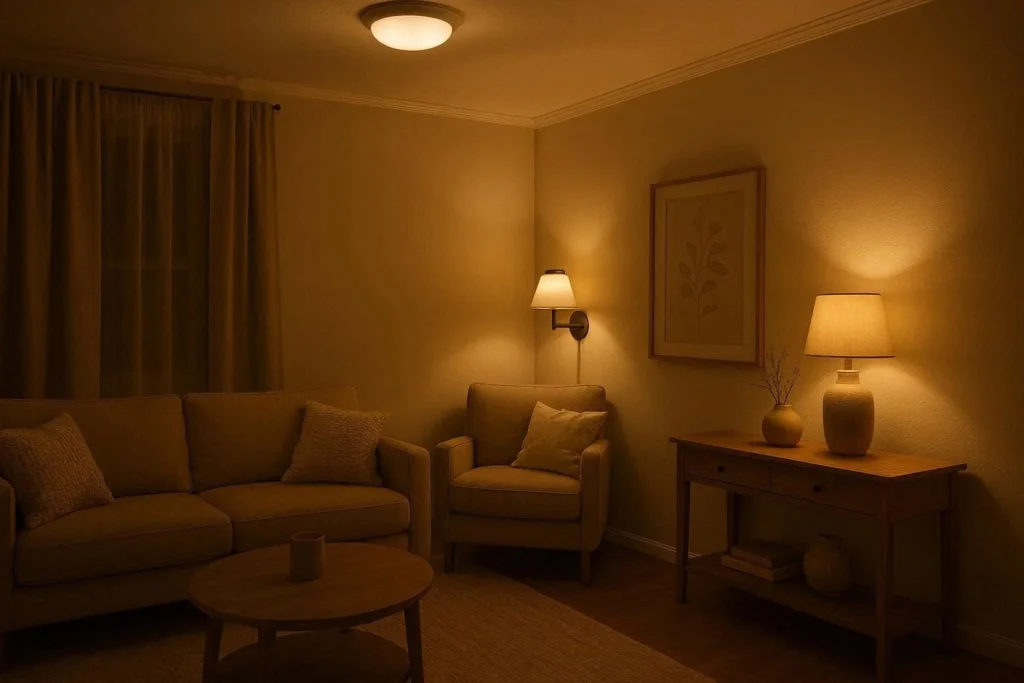
Ambient light is the room’s base illumination. This can come from an overhead fixture, but it works better when that fixture has a dimmer, so you can lower the light level in the evening. Recessed lights work well in low-ceiling rooms. A ceiling-mounted fixture with a shade that diffuses light upward (rather than downward) creates a softer effect.
Task lighting serves specific functions: reading, working, illuminating a desk area. A wall-mounted swing-arm lamp over a reading chair, or a table lamp on a console, adds light where it’s needed without adding the visual mass of a floor lamp that competes for floor space.
Accent lighting draws attention to something worth seeing: a bookshelf, a piece of art, a plant on a high shelf. LED strip lights on the underside of a wall-mounted shelf, or a small picture light mounted above a piece of art, add a layer of depth that flat ambient light cannot.
Together, these three layers make the room feel like it has dimension at night, rather than an evenly lit box.
A rug that’s too small a 4 x 6 or 5 x 7 in a room that needs an 8 x 10 creates the impression that the floor is floating separately from the furniture. All front legs of the seating arrangement should be on the rug, minimum.
Ten small objects on a shelf read as clutter. Three objects of varying height read as a composition. In small rooms, edit ruthlessly and group rather than spread. Display items that mean something and remove the rest from the room entirely.
A sectional that fits technically where the dimensions work on paper but consumes 70 percent of the floor area isn’t the right choice. Seating that’s right-sized for the room and supplemented by pull-out options when needed serves small rooms better than one large piece.
Furniture placed directly in front of a window cuts the room’s primary light source. Even a few inches of clearance between furniture and window allows light to flow into the room. Sofa arms should clear window sills, not sit below them.
Empty floor space is not wasted space it’s what makes the room feel breathable. Resist the impulse to fill every area. A deliberately open corner reads as intentional. A filled-in corner with an unused plant stand and random accent table does not.
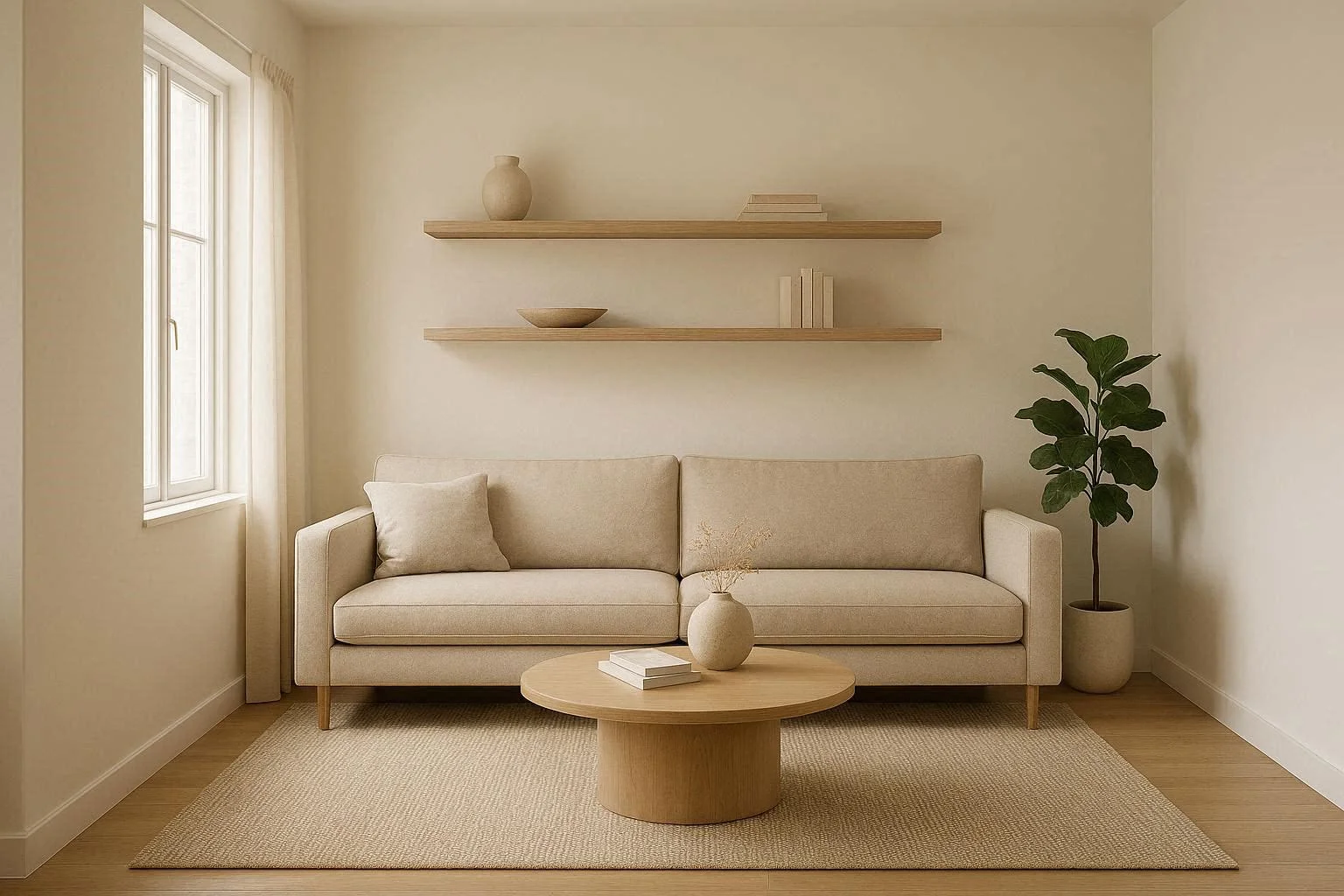
A room this size can accommodate a 72-inch sofa, a narrow 10-inch-deep console behind it, and a small round coffee table (round tables allow better circulation than rectangular ones in very tight spaces). One wall of floor-to-ceiling shelving provides storage and display. Lighting is handled by a single pendant over the coffee table and two sconces flanking the shelves. The palette is monochromatic varying tones of the same off-white with texture variations in linen, cotton, and a woven rug.
A family living room needs to accommodate more use: toys, books, seating for adults and children. A 84-inch sofa is paired with a large storage ottoman that doubles as a coffee table and toy chest. Modular floating shelves (closed units at lower heights, open display above 48 inches) keep children’s items accessible but organized. A large washable rug anchors the space. The room uses two distinct seating heights the main sofa for adults, floor cushions for children to create functional zones within the same footprint.
A 10 x 20 foot room in a townhouse is zoned into two 10 x 10 areas: a main seating area at the front with a sofa and two chairs facing each other, and a secondary zone near the back with a reading chair, side table, and floor lamp. A long console table runs along one of the long walls with art grouped above it. Two different rugs one 8 x 10, one 4 x 6 define each zone. This approach connects directly to townhouse decorating ideas, where long, narrow footprints require thoughtful zoning across multiple levels.
When the living room is also the dining room, bedroom, and office, zones are created by furniture placement rather than walls. The sofa faces away from the bed, creating a psychological separation. A bookshelf on casters can act as a room divider when needed. The desk faces a wall with a window, pulling task activity to the perimeter. Lighting in each zone is distinct a pendant marks the dining area, a floor lamp marks the reading zone, bedside sconces mark the sleeping area so no single overhead light controls the entire space.
Awkward layouts in rentals off-center windows, doors in unexpected places, low ceilings, structural pillars require design flexibility. Work with the awkwardness rather than against it. A structural pillar can become a display surface. A door that interrupts a wall can be flanked symmetrically with sconces or plants. Low ceilings benefit from simple, flat window treatments that don’t draw attention to the ceiling height. When you can’t paint, a large-scale rug and a gallery wall (using adhesive strips, not nails) carry most of the design weight. If you’re working with a compact home beyond just the living room, explore our budget-friendly home decorating guides for practical, room-by-room inspiration.
The most effective approaches are layout-first: pull furniture away from walls, use a large enough rug, maintain clear walkways, and choose furniture with exposed legs. Then address light add mirrors opposite windows and introduce layered lighting rather than relying on a single overhead source. Finally, simplify the color palette and reduce the number of competing objects on display. These work cumulatively: any two or three of them together will make a visible difference.
Yes, with conditions. A sectional works in a small room if it fills an otherwise wasted corner, if it’s proportioned for apartment-scale use (think 90 x 90 inches or smaller), and if it doesn’t prevent clear 30-inch walkways on all functional sides. A full-sized sectional in a room under 180 square feet almost never works. If you’re uncertain, tape out the sectional’s footprint on your floor and live with it for a week before buying.
Light, warm neutrals creamy whites, pale greiges, soft sage reflect more light and make walls appear to recede, creating the perception of more space. This is the most reliable approach. However, a monochromatic dark scheme can also work by creating visual cohesion that makes the room feel intentional rather than cramped. What doesn’t work well is high contrast dark furniture against bright white walls, or multiple competing colors which adds visual busyness that makes the room feel smaller.
Not necessarily, but it should be larger than you think. In a small living room, a rug that extends 6 inches beyond the outermost furniture legs on all sides is the goal this is usually an 8 x 10 rug in a room that most people would instinctively equip with a 5 x 8. A rug that’s too small makes the room feel fragmented. Wall-to-wall carpet is a different matter it removes the visual boundary of the rug and can actually make a room feel more expansive, but it’s a permanent (or semi-permanent) change.
A useful threshold: if you can’t walk a clear 30-inch path from any entrance to any seating without redirecting, you have too much furniture. Another test: if more than 60 percent of the floor area is covered by furniture footprints (excluding the rug), the room will feel congested. In practice, a small living room under 200 square feet typically accommodates a sofa, one or two side chairs or a pair of accent chairs, a coffee table or ottoman, and one or two side tables. Every additional piece requires removing something else.
In rooms under 250 square feet, a 72 to 84-inch apartment-size sofa with slim arms and exposed legs typically works best. Oversized 96-inch sofas usually disrupt circulation and make small rooms feel crowded.
The most important small living room decorating idea is the one that happens before you open a single browser tab or step into a store: figure out the layout. Where furniture sits, how people move through the room, and what clearances are maintained determines whether everything else you do will work or fight against itself.
From there, scale matters more than style. The right sofa at 78 inches will outperform a beautiful sofa at 96 inches in a room that can’t absorb the difference. A single large art piece outperforms six small ones. One considered light fixture beats four lamps competing for floor space.
Small spaces reward restraint and intentionality more than larger rooms do, because there’s less room for error to hide. But they also respond quickly to thoughtful decisions. Move the furniture, hang the right mirror, add a layer of lighting and a room that felt tight yesterday can feel considered and calm today. That’s the real promise of good small living room decorating ideas: not magic, but logic applied to limited square footage.